
The Pickup for Minimalists: The DeKalb Lumberjack Gave Up Everything for Cargo Space
Today’s commercial vehicle market is packed with enclosed cargo vans and pickups that are refined, comfortable, and practical—but few stand out.
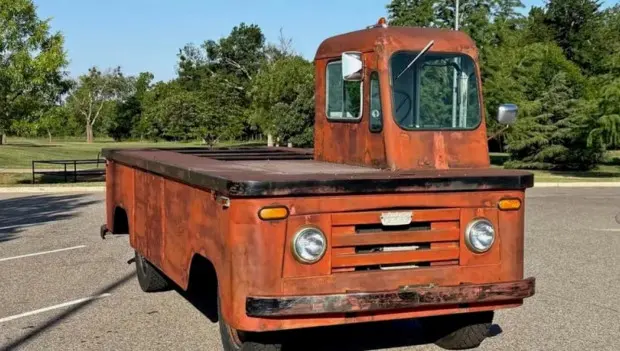
Today’s commercial vehicle market is filled with enclosed vans and pickup trucks that are thoughtfully engineered, comfortable, and practical. The downside? They all tend to look and feel the same. Back in the 1960s, things were very different. When engineers developed the DeKalb Lumberjack, they reached a simple conclusion: a truck built for a lumberyard shouldn’t carry anything it doesn’t absolutely need.
A conventional pickup was considered an unnecessary luxury when the job involved hauling logs, lumber, and long lengths of pipe. The DeKalb Lumberjack may be the most minimalist work truck ever built. It looked less like a pickup and more like a motorized industrial cart—except this one came with V8 power. While today’s contractors arrive at the job site in predictable cargo vans, an American builder in the 1960s could pull up in this wonderfully odd asymmetrical machine.
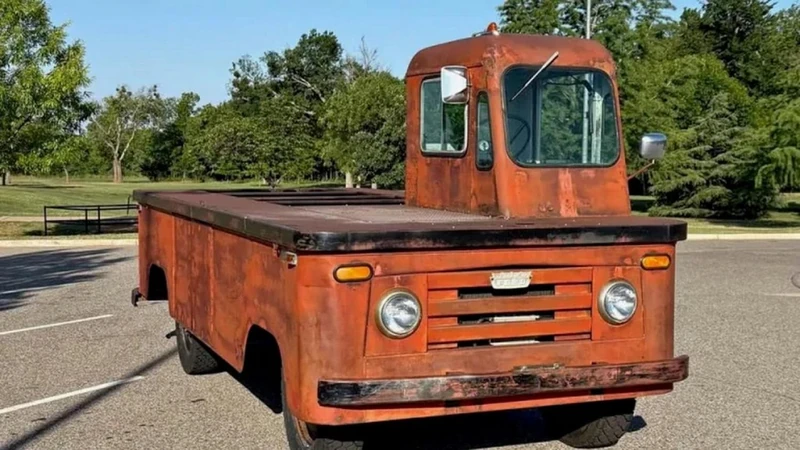
The unusual truck was created for Bond-Howell Lumber after the company realized in the mid-1950s that standard pickups were awkward to maneuver around crowded lumberyards. Tight working spaces and commercial vehicle regulations pushed the company to look for a completely different solution. Engineers at DeKalb Commercial Body Corporation—formerly the Sycamore Wagon Works carriage company founded in 1904—responded with an exceptionally creative design.
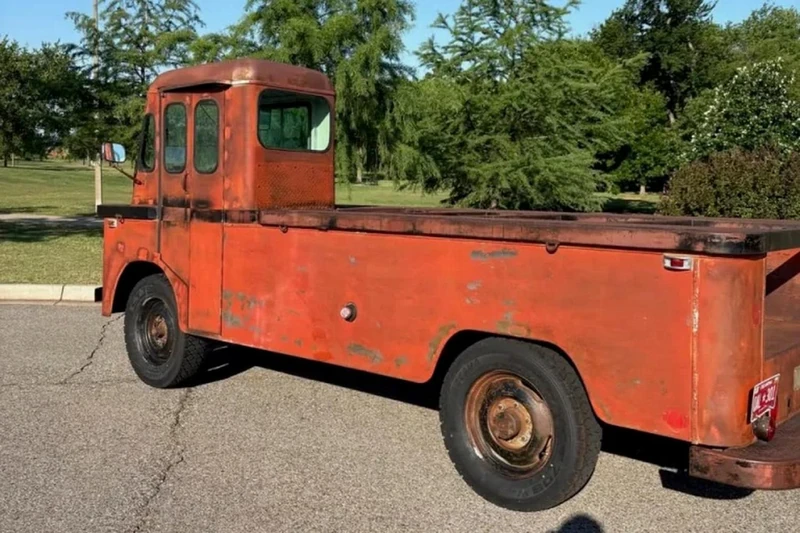

Instead of a conventional cab, they built a tiny one-person driver’s compartment and moved it to the front-left corner of the chassis, freeing up as much room as possible for cargo. Everything else that wasn’t essential was eliminated. The finished truck measured just 15.7 feet long, making it short enough to fit in a standard parking space. Thanks to its unconventional layout, however, it could carry remarkably large loads.
Long boards and pipes could be loaded alongside the cab, while a second cargo level was tucked beneath the main floor. Engineers also added a lockable storage compartment between the wheels on the passenger side—a concept surprisingly similar to the storage boxes found on modern Ram pickups. The result was an almost perfect vehicle for construction sites and lumber operations. Even better, it tipped the scales at only about 2,870 pounds. According to DeKalb, three Lumberjacks could perform the work of five conventional pickups.


DeKalb built its distinctive body on a variety of chassis supplied by manufacturers including Dodge and Chevrolet. More recently, an example based on a 1960 Ford P-350 chassis surfaced for sale in Oklahoma. The “P” designation stood for “Parcel Delivery,” as these chassis were originally developed for step vans and postal delivery trucks. The truck’s exact mileage was unknown, although its owner claimed to have personally driven roughly 10,000 miles.
The unrestored truck, complete with genuine decades-old patina rather than a glossy show-quality finish, was offered for about $22,000 and reportedly sold almost immediately. There was also a slightly more civilized version called the Lumber King, built on the Chevrolet P35 chassis. One of those changed hands in 2022 for $19,500. Even so, the King was the softer option. The Lumberjack was the true no-compromise workhorse.


It had no heated mirrors—because it had no mirrors. There was no climate control, and the tiny cab was anything but weatherproof. Sound insulation was nonexistent, and creature comforts amounted to little more than a small seat mounted above the engine. In exchange, owners got nearly 64 square feet of usable cargo space packed into an incredibly compact footprint.
The DeKalb Lumberjack was built with one purpose in mind: hauling more material while wasting less space. For anyone willing to sacrifice comfort in the name of productivity, it may have been one of the most ingenious construction trucks ever created.
You may also be interested in the news:
Ford Ranger FX4 Level II Was Cool Long Before the Raptor
Ford Built This Insane Ranger Years Before the Raptor—and Almost Nobody Remembers It

This 18-Year-Old Audi RS4 Just Sold for More Than It Cost Brand-New
After spending 18 years in a garage, this low-mileage Audi RS4 has become a sought-after collector car.

Tennessee Man Builds an Absurdly Wide Car Where Everyone Gets to Ride Shotgun
Tennessee creator Tyler Fever built an absurdly wide car after previously turning a Ford Festiva into a street-legal sliver.

Washington Man Steps in Front of Tesla Cybercab to Test Its Self-Driving Response
Washington man stepped into a Cybercab’s path to test how quickly its autonomous system responded.

Copart to Acquire ACV Auctions in $1.9 Billion Deal, Expanding Into Dealer-to-Dealer Car Auctions
Copart is acquiring ACV Auctions for about $1.9 billion, expanding its online auction business into dealer-to-dealer vehicle sales.