
Flying Pug: Why Mitsubishi Built a Pajero That Looked Like a London Taxi
In the late 1990s, Mitsubishi introduced one of Japan's most unusual limited-edition SUVs, blending retro British styling with compact off-road capability.
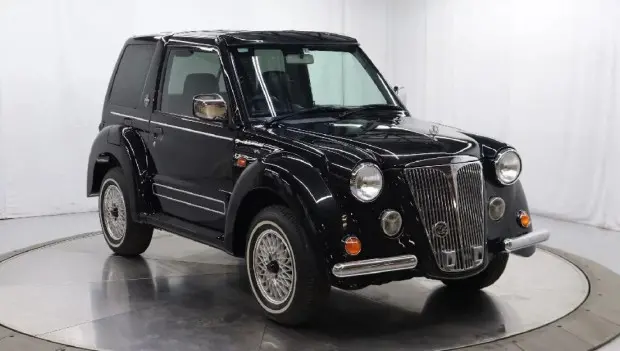
In the late 1990s, Japan produced one of the automotive world's strangest styling experiments. Mitsubishi, a company known for its practical and engineering-focused approach, decided to give its compact Pajero Jr. the look of a British gentleman. The result was the Flying Pug—a special edition that looked as though it had been designed in London half a century earlier rather than in Japan at the end of the 20th century.
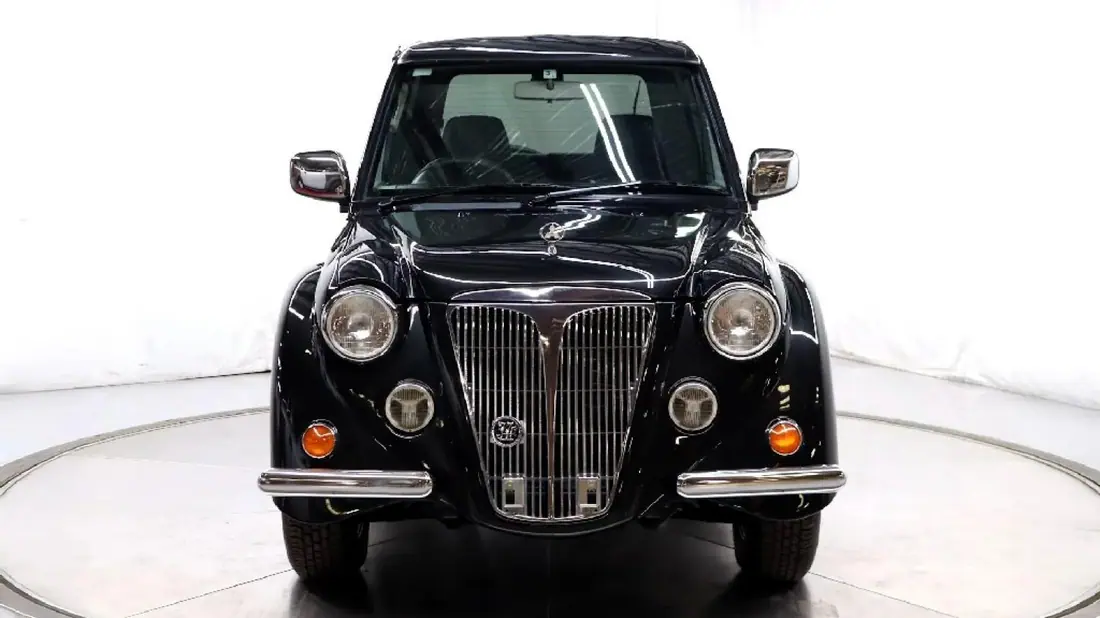
Mitsubishi originally planned to build 1,000 examples. Buyers, however, never embraced the retro-inspired styling, and production ended after just 139 vehicles. That was a sharp contrast to the earlier McTwist and Lynx special editions, each of which sold out with production runs of 1,000 units.

The designers clearly embraced the growing retro trend, but the marketing strategy missed the mark. Today, one of these ultra-rare Flying Pugs, finished in black and showing about 80,800 miles, is preparing to cross the Pacific and will head to auction this September.

The Flying Pug was based on the standard Pajero Jr., featuring a three-door body-on-frame design, a shortened Minica platform, and a four-wheel-drive system with a low-range transfer case. Its styling, however, was unlike anything else.
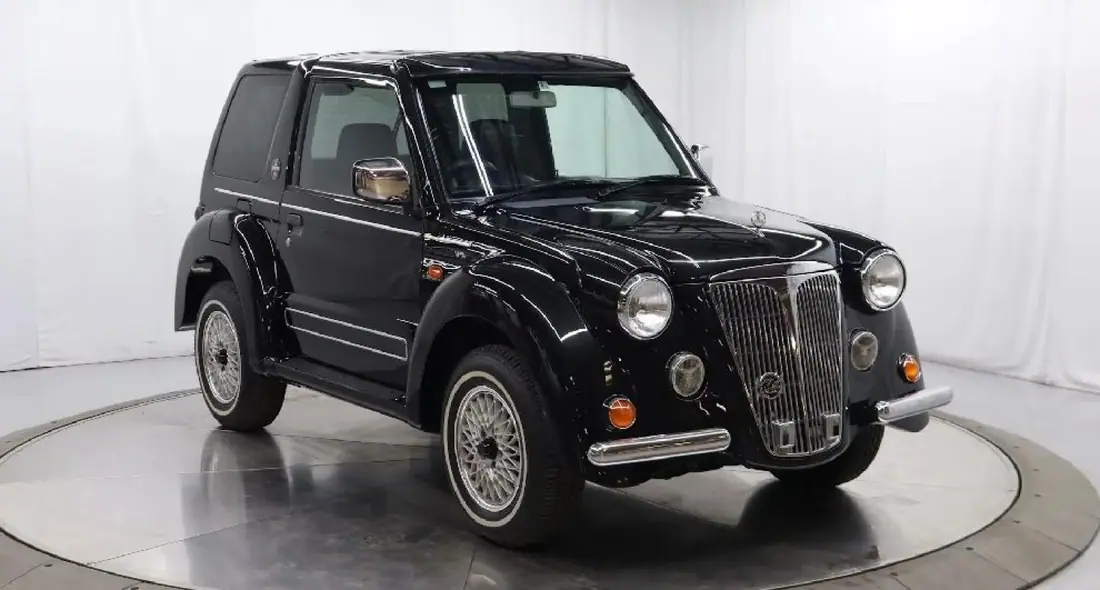
A massive chrome grille, oversized fender flares, round 1950s-style headlights, and generous amounts of chrome transformed its appearance. Silver wheels wrapped in whitewall tires, along with fender-mounted side mirrors, completed the look. The result resembled a scaled-down London taxi far more than a Japanese SUV.

Under the hood was a naturally aspirated 1.1-liter inline-four producing 80 horsepower and 72 lb-ft of torque. Those figures may seem modest, but with a curb weight of just 2,138 pounds, the little SUV had enough performance for city driving and occasional trips onto light trails.

Power was sent through a three-speed automatic transmission, although a five-speed manual was also offered, while the part-time four-wheel-drive system featured both 4H and 4L modes.

Technically, the Flying Pug was a genuine off-road vehicle—just a very small and very unusual one. It was never designed for racing or tackling extreme terrain, but as a collector's item or a standout attraction at a Cars & Coffee event, it remains hard to match. Its rarity and delightfully unconventional styling have made the Flying Pug a cult favorite, and it may soon find a new owner in the United States, where examples are almost impossible to find.
You may also be interested in the news:

You Won’t Recognize This Toyota: Tuners Turned the Crossover Into a Sports Car
Modellista has prepared two new styling packages for the updated Toyota Harrier.

Mitsubishi Delica D:5 Transformed Into a Cozy Camper With a Bedroom and Air Conditioning
A new camper project based on the popular Mitsubishi minivan has been unveiled.

Honda S2000 Type R Rendered as a 2028 Model in Independent Digital Images
A virtually revived Honda S2000 gets an aggressive Type R version

Toyota Camry Facelift Imagined in New Concept Renders
A potential Toyota Camry facelift could bring sharper styling and a plug-in hybrid powertrain to the popular midsize sedan.
14 Inspiring DIY Ideas to Turn Car Scrap into Home Decor and Furniture
From furniture to lighting, these creative projects turn discarded automotive parts into something useful again.