
Why Your Engine Might Be Trying to Kill You in a Crash (And How VW Just Fixed It)
The “dogbone” engine mount may be on its way out as Volkswagen patents a design aimed at improving crash protection.

Volkswagen has surprised the automotive industry with a patent for an innovative engine mount that could change the approach to passive safety. Few people realize that this component is often overlooked when discussing driver and passenger protection. What risks do conventional designs pose, what does the new development promise, and why is it especially relevant now? Here’s a closer look.
For U.S. motorists, news of Volkswagen filing a patent application with Germany’s German Patent and Trade Mark Office (DPMA) for a new lower engine mount could be particularly significant. With road safety remaining a major concern, any technology capable of reducing the consequences of crashes is drawing increased attention. The automaker’s engineers have proposed a design that could change conventional ideas about protecting drivers and passengers in frontal collisions.
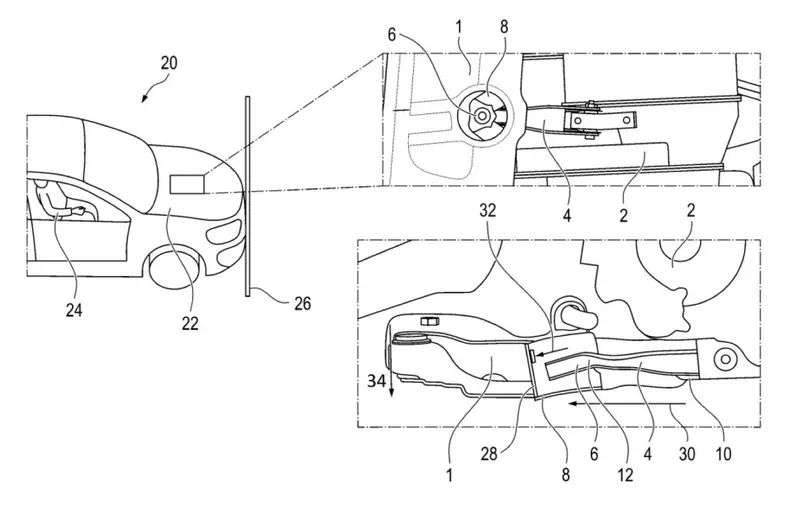
The traditional pendulum mount, known among specialists as a “dogbone” mount, serves two purposes: It keeps the powertrain in place and dampens vibrations generated by the engine. However, in serious crashes, conventional mounts can deform unpredictably, causing the engine to shift and transferring some of the crash energy into the passenger compartment. This can lead to additional injuries for people inside the vehicle.
Volkswagen has taken a different approach to the problem. The new mount has different stiffness characteristics in the horizontal and vertical planes. This allows it to absorb crash energy more effectively in a frontal collision while minimizing the transfer of crash loads to the vehicle body and occupants. Under normal driving conditions and in minor crashes, the component retains its strength and does not require expensive repairs.
Interestingly, Volkswagen has not yet disclosed when the new technology could be introduced in production vehicles. However, the patent itself indicates that the automaker is serious about the technology. Automakers have increasingly focused on passive safety in recent years, and Volkswagen is no exception. Experts say solutions like this could eventually become standard on mainstream models, particularly as safety requirements continue to become more stringent.
German engineers are not the only ones looking for ways to improve occupant protection. GM, for example, has already introduced a seat with an integrated neck airbag, while automakers in other countries are actively testing new body materials. In this context, Volkswagen’s innovation looks like a logical continuation of a broader global trend. Other brands are also showing interest in new safety technologies: A hybrid crossover recently entered the market that experts say could change the approach to hybrids — more details can be found in the article about the launch of the Avatr 07.
For reference: A pendulum mount is a powertrain component that absorbs part of the loads generated during driving and crashes. Its design directly affects how the engine behaves in a collision. According to Rossiyskaya Gazeta, Volkswagen’s new development could be an important step toward reducing crash injuries, particularly in mainstream vehicles. If the technology lives up to expectations, similar solutions could appear from other automakers in the coming years.
You may also be interested in the news:

This Weird 1973 Volkswagen Has No Reserve—and It Could Sell for Thousands
A rare 1973 Volkswagen Thing will cross the auction block in the U.S. later this month with no reserve.

Your Steering Wheel Starts Shaking at 60 MPH? Don’t Ignore These Warning Signs
A vibrating steering wheel is often most noticeable at highway speeds, but the cause isn’t always immediately obvious.

Volkswagen Recall Bombshell: 250,000+ Vehicles Hit by Steering Failure and Sudden Engine Stall Risks
Volkswagen is recalling more than 250,000 vehicles in the U.S. over steering, software and engine-stall concerns.
Volkswagen Just Did the Unthinkable: The New GTI Is Rear-Wheel Drive
Volkswagen's ID.3 GTI reaches 60 mph in 5.6 seconds and offers 373 miles of range.
Volkswagen Mission Efficiency Concept Sets Three World Records, Looks Like a 13-Year-Old Model
Volkswagen has unveiled the new Mission Efficiency concept, a radical electric coupe focused on maximizing range and energy efficiency.