
The Billion-Dollar Mistake: How Cadillac Built a Masterpiece Nobody Wanted to Buy
Cadillac poured cutting-edge technology and luxury into the XLR, but buyers never embraced its six-figure price tag.
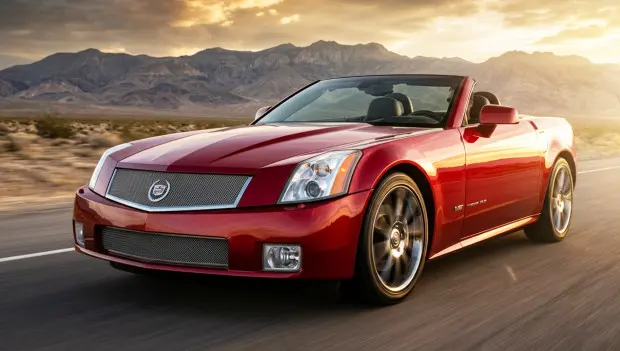
Cadillac has produced its share of flops over the years. One of the most famous was the Allanté convertible introduced in 1986. Then, in the early 2000s, General Motors executives decided to revisit that forgotten formula, launching the equally ambitious—and ultimately equally unsuccessful—Cadillac XLR. So what went wrong this time?
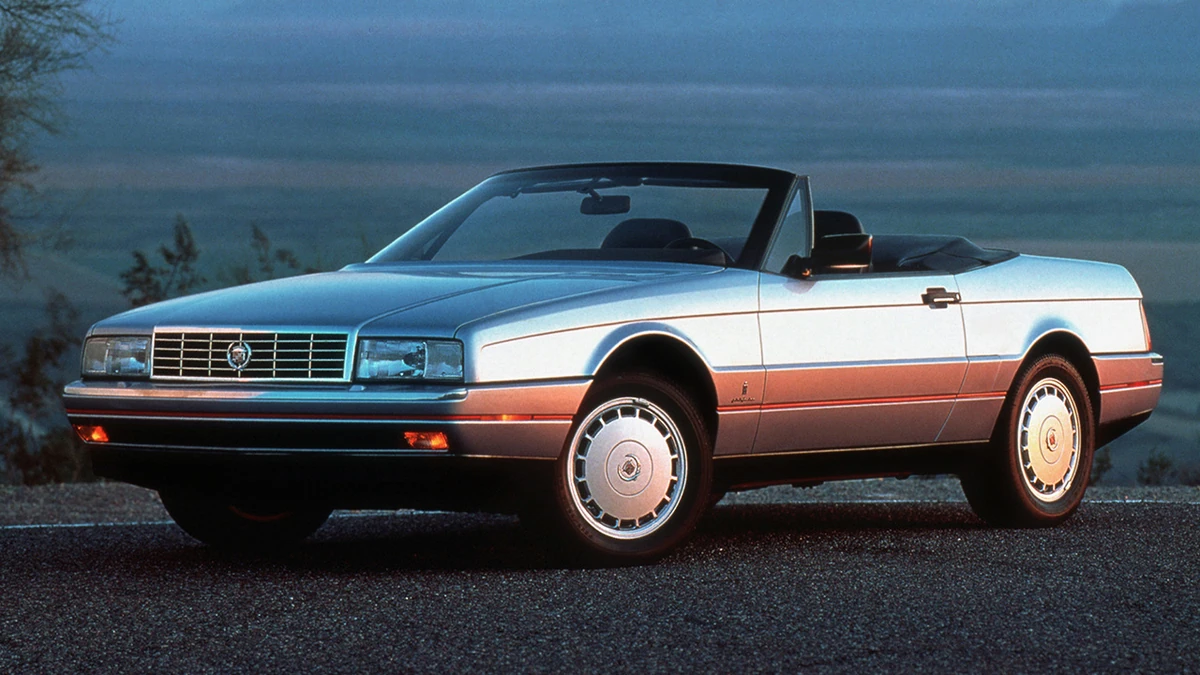
The Cadillac XLR ended up following almost the same path as the ill-fated Allanté introduced in the late 1980s
The Allanté was a landmark vehicle for Cadillac. In the late 1980s, the brand was determined to reclaim a place in the luxury personal-car segment dominated by European automakers, and GM spared no expense. The design was commissioned from Italy’s Pininfarina, which also built the bodies before they were flown to Michigan for final assembly. That elaborate logistics chain came at a steep cost, making the Allanté extraordinarily expensive. The car carried a starting price of $55,000, while a Mercedes-Benz SL equipped with a 5.5-liter V8 cost just $48,000. To make matters worse, the Cadillac rode on GM’s mass-market front-wheel-drive E-body platform, hardly the foundation buyers expected for a premium sports car. The result was predictable: just over 21,000 units sold versus an original target of 50,000.
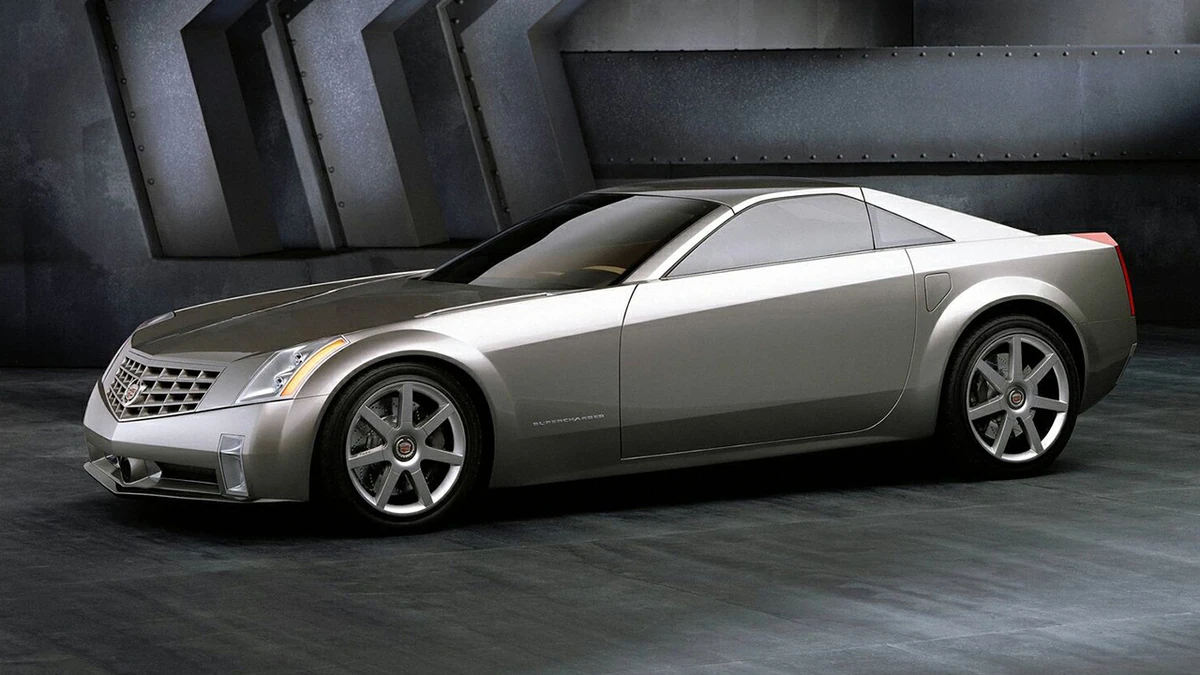
The XLR traces its roots to the 1999 Evoq concept, which introduced Tom Peters’ sharp-edged “Art & Science” design language
When development of the XLR began, Cadillac tried to avoid repeating past mistakes. Engineers selected the rear-wheel-drive Y-body platform from the Chevrolet Corvette as the foundation. The roadster also borrowed Corvette’s hydroformed frame structure, composite body panels, and advanced rear-mounted transaxle layout that integrated the transmission and rear differential into a single unit. Beyond those elements and some suspension components, however, the two cars shared little mechanically.
While the Corvette C6 received GM’s new 6.0-liter LS2 V8 producing 400 horsepower, the XLR was powered by Cadillac’s own 4.6-liter Northstar LH2 V8 rated at 320 horsepower.
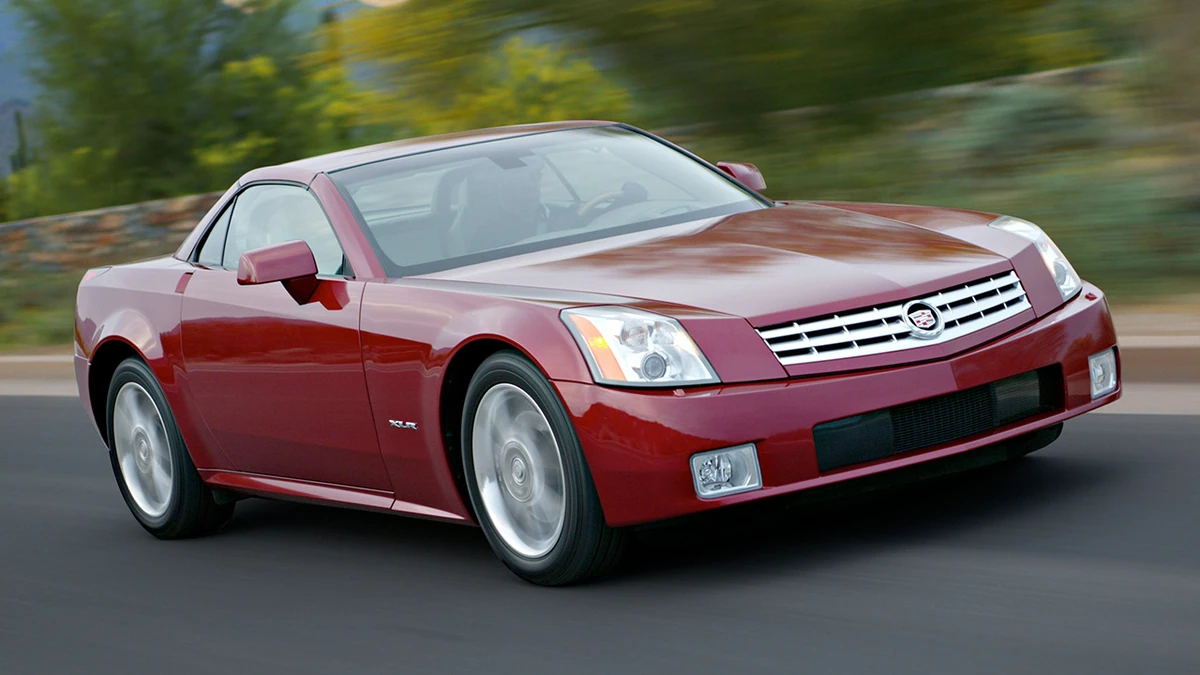
Unlike the rounded sports cars of its era, the XLR featured a sharp, angular design that still looks distinctive today
Interestingly, earlier Northstar engines were mounted transversely, but the LH2 was extensively redesigned for longitudinal installation. Engineers reworked the aluminum block casting, redesigned the mounting points, and created entirely new intake and exhaust systems. Variable valve timing, electronic throttle control, and precision crankshaft balancing helped deliver exceptionally smooth and quiet operation.
Cadillac also believed that a traditional soft-top convertible lacked the sophistication expected in a luxury flagship. Instead, the XLR received a power-retractable hardtop built around a magnesium-aluminum structure that could fold away in just 29 seconds. The system added roughly 550 pounds compared with a Corvette, but the XLR was never intended to be a track-focused sports car. Its mission was effortless high-speed cruising on highways and scenic back roads.
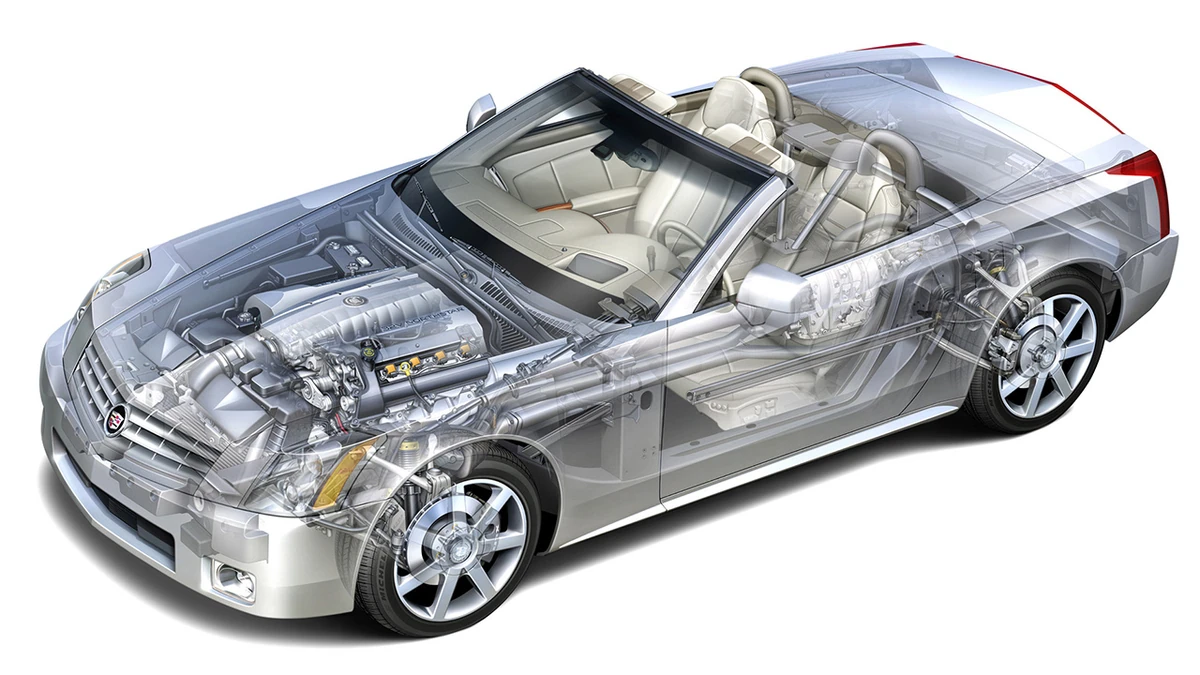
The Northstar LH2 combined impressive performance with questionable reliability. Common issues included cylinder-head bolt failures, rear main seal leaks, and a troublesome water-cooled alternator
Although the XLR could not match the Corvette's performance, it easily surpassed it in luxury and technology. The roadster came equipped with an advanced infotainment system featuring a color display and navigation, full power accessories, heated and ventilated seats, a Bose audio system with speakers integrated into the headrests, a head-up display, adaptive cruise control, and keyless entry.
One of its standout features was Magnetic Ride Control. The shock absorbers were filled with magnetorheological fluid containing millions of microscopic iron particles. By altering electrical current, the system could instantly change the fluid’s viscosity and adjust damping characteristics in real time. Combined with sensors monitoring body movement, steering input, and wheel position, the setup delivered an exceptional balance of ride comfort and handling. The technology proved so successful that it later appeared in vehicles such as the Ferrari 599 GTB and Audi R8.
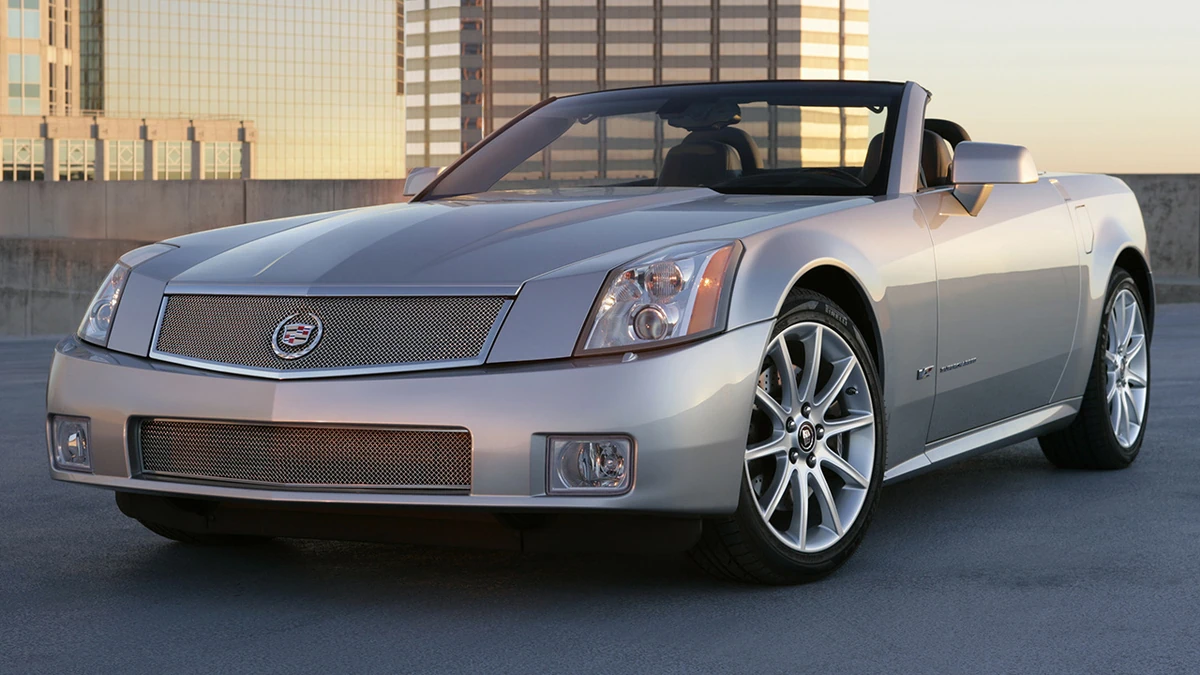
The high-performance XLR-V was distinguished by its raised hood, mesh grille, and unique 19-inch 10-spoke wheels
Following its debut at the 2003 Detroit Auto Show, the XLR received widespread praise from automotive journalists. Most reviewers agreed that the car was distinctive, refined, and well-executed—but also painfully expensive. The standard XLR started at $75,000, while the high-performance XLR-V introduced for 2005 carried a sticker price of $100,000.
The XLR-V featured a supercharged 4.4-liter Northstar LC3 V8 producing 443 horsepower, upgraded Corvette Z51 brakes, and 19-inch wheels. According to testing by Car and Driver, the XLR-V accelerated from 0 to 60 mph in just 4.6 seconds and was electronically limited to 155 mph. Respectable numbers, but perhaps not enough to justify a price equivalent to two Cadillac Escalade SUVs or roughly three Ford Mustang GT coupes at the time.
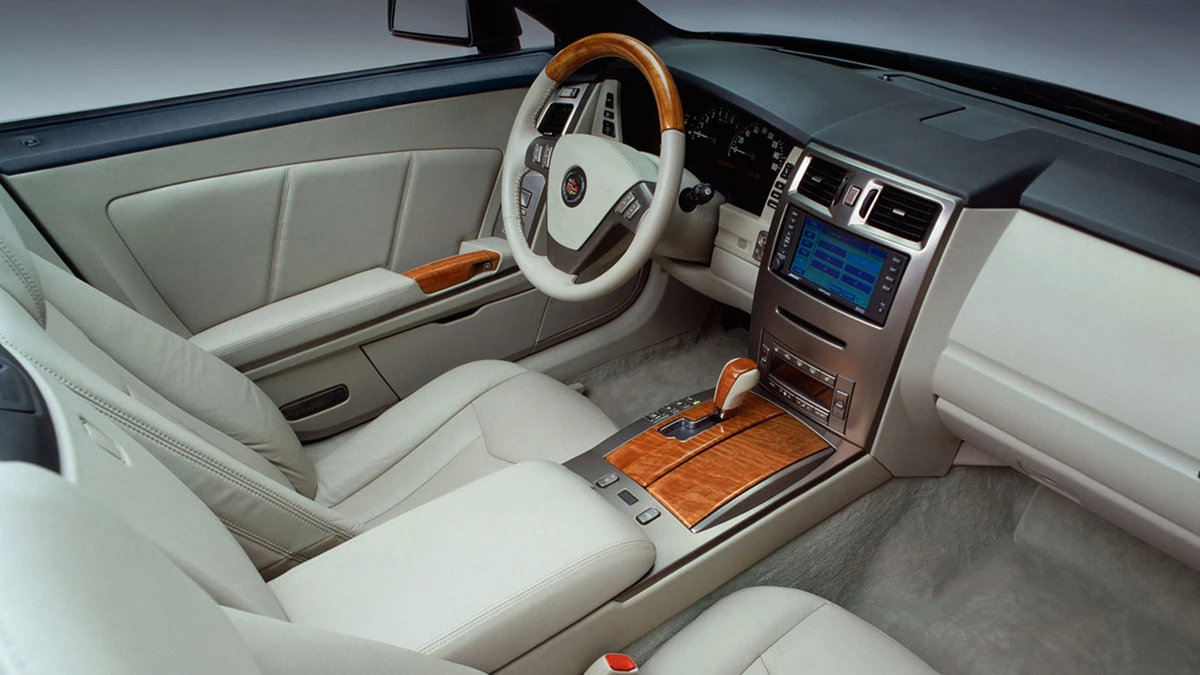
One of the cabin’s signature touches came from GM’s partnership with Italian luxury jeweler Bvlgari. The company designed custom gauge fonts, an analog center-console clock, and even the housing for the electronic key fob
GM management envisioned annual sales between 5,000 and 7,000 units, but reality proved far less forgiving. The XLR reached its peak in 2005 with 3,730 vehicles sold, a figure that would remain its all-time high. By 2007, sales had been cut in half, and during its final production year in 2009, Cadillac managed to sell only 787 examples.
In the end, the XLR almost perfectly mirrored the fate of the Allanté. Both cars were conceived as revolutionary flagship models, yet both ended in commercial failure. Then again, Cadillac has a long history of learning the same lesson more than once—just ask anyone familiar with the Cimarron or Catera.
You may also be interested in the news:
Volkswagen Recall Hits 250,000+ Vehicles Over Steering Failure and Sudden Engine Stall Risks
Volkswagen is recalling more than 250,000 vehicles in the U.S. over steering, software and engine-stall concerns.

You've Seen These Black-and-Yellow Road Markers—But Do You Know What They Really Mean?
Those familiar black-and-yellow road markers quietly tell drivers which direction to take around roadside obstacles.
The New Nissan Rogue Is Here—and Its Hybrid Powertrain Changes Everything
The new Nissan Rogue makes its U.S. debut with a ground-up Nissan design and an all-new hybrid powertrain built around electric motors.
10 Wild BMW Concepts That Never Made It to Production — And the Cars They Inspired
From the Turbo to the M1 Hommage, these 10 BMW concepts showed ideas the automaker never brought to showrooms.
Why Small Turbo Engines Are Replacing Big V8s—and What It Means for Your Next Car
Turbochargers let automakers squeeze big-engine performance from smaller engines—but the technology comes with trade-offs.