
Qualcomm and Google: A Decade-Long Alliance to Build Smarter Cars
In Las Vegas, Qualcomm and Google announced an expanded partnership expected to last more than a decade

At the start of the year at CES in Las Vegas, Qualcomm and Google revealed plans to significantly expand their long-running partnership—one designed to stretch well into the next decade. The goal is ambitious: to lay the groundwork for vehicles that don’t just respond to driver commands, but actively anticipate what the driver wants.
From infotainment to a “digital brain”

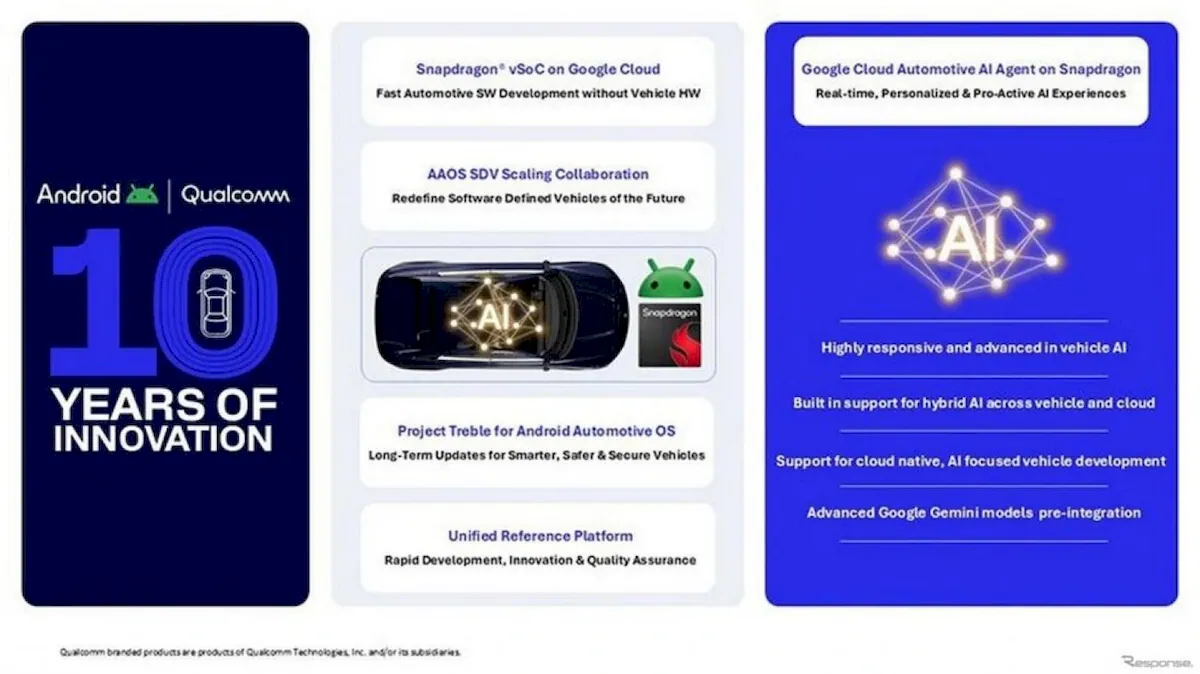
The collaboration between the two tech giants began nearly ten years ago with early automotive systems based on Android and Snapdragon processors. The new phase goes much deeper, centering on tight integration between Qualcomm’s Snapdragon Digital Chassis and Google’s Android Automotive OS (AAOS). Together, they aim to create a unified platform that allows automakers to design, test, and bring new vehicles to market faster.
A key element of this approach is a hybrid artificial intelligence architecture. Advanced AI algorithms will run partly on powerful Snapdragon chips inside the vehicle and partly in Google Cloud. This setup enables systems capable of handling complex, multi-step tasks on their own. In practical terms, that could mean a voice assistant that doesn’t just turn on seat heaters, but prepares the cabin and maps out a route for a Friday trip to the countryside—based on your habits and preferences.
Software updates like a smartphone
One of the biggest headaches for modern vehicles is how quickly their software becomes outdated. The new alliance aims to change that. Qualcomm and Google plan to apply the Project Treble concept, familiar to Android smartphone users, to the automotive world. This would allow large-scale software updates without interfering with each automaker’s unique user interface.
For drivers, that means new features and security updates arriving far more frequently—much like on a phone. For engineers, Qualcomm is introducing a major new tool: the Snapdragon vSoC virtual platform hosted in Google Cloud. It allows full-scale development and testing of automotive systems in the cloud, eliminating the need for costly hardware during early development stages. The result could be shorter development cycles and significantly lower costs.
Not a concept—already on the road
This isn’t just a vision for the future. CES 2026 showcased a real-world example. Chinese automaker Leapmotor unveiled what it calls the world’s first production automotive computer powered by dual Snapdragon Elite chipsets (SA8797P). The system consolidates infotainment, safety functions, and telematics into a single architecture and is set to debut in the new Leapmotor D19 crossover.
Qualcomm’s automotive partner network is also expanding rapidly. Companies such as Li Auto, Zeekr, NIO, and Chery are already on board, while Toyota has selected the Snapdragon Cockpit platform for the next-generation RAV4.
Taken together, the Qualcomm–Google alliance represents a concrete step toward a future where cars are no longer a collection of disconnected electronic modules, but unified, intelligent systems that learn over time and continuously improve—much like the devices people already carry in their pockets.
You may also be interested in the news:

Hyundai Recalls Nearly 95,000 Genesis Sedans Over Fire Risk From Power Seats
Hyundai is recalling 94,622 Genesis sedans after a faulty power seat switch was linked to overheating and potential vehicle fires.

2027 Ram 1500 Rumble Bee: Pricing, Options and How to Build Yours
The 777-HP Ram Rumble Bee Is Coming — But You Can Buy the New Hemi Truck Now

Why Experienced Drivers Still Warn Against Buying a Used Car With a CVT
CVTs offer smooth acceleration and good fuel economy, but expensive repairs and durability concerns make used models risky.
2026 Ram 1500 Recall: 16K Trucks May Have Faulty Tire Pressure Sensors
Ram is recalling 16,385 model-year 2026 Ram 1500 trucks

Harley-Davidson Riders Could Face $2,500 Fines Under New Law Targeting ‘Weaving’ on Roads
Arizona’s new motorcycle law targets lane splitting, exposing repeat offenders to steep fines, possible jail time, and license suspensions.