
Only Two Giants Left: The LARC-LX 52 4x4 — the Largest Off-Road Vehicle Ever, Weighing Nearly 90 Tons with Four Engines
The first thought when you see this machine isn’t “SUV” — it’s more like a floating power plant on wheels.

Calling the vehicle we’re talking about today a “car” feels almost wrong. When you’re staring at nearly 62 feet of steel, diesel engines, propellers, and massive tires, your first thought isn’t off-road vehicle — it’s some kind of floating industrial facility on wheels. Only after a closer look does it click: this is the legendary LARC-LX 52, one of the wildest feats of engineering still in existence.
An American-built wheeled amphibian. Curb weight: about 88 tons. Payload capacity: up to 132 tons on land. Power: four diesel engines producing 265 horsepower each. It sounds like something dreamed up by an overtired logistics officer — but this monster is very real. It drives, floats, turns, and carries vehicles that wouldn’t even fit on a standard ferry.
When the Marine Corps says, “We need something bigger”
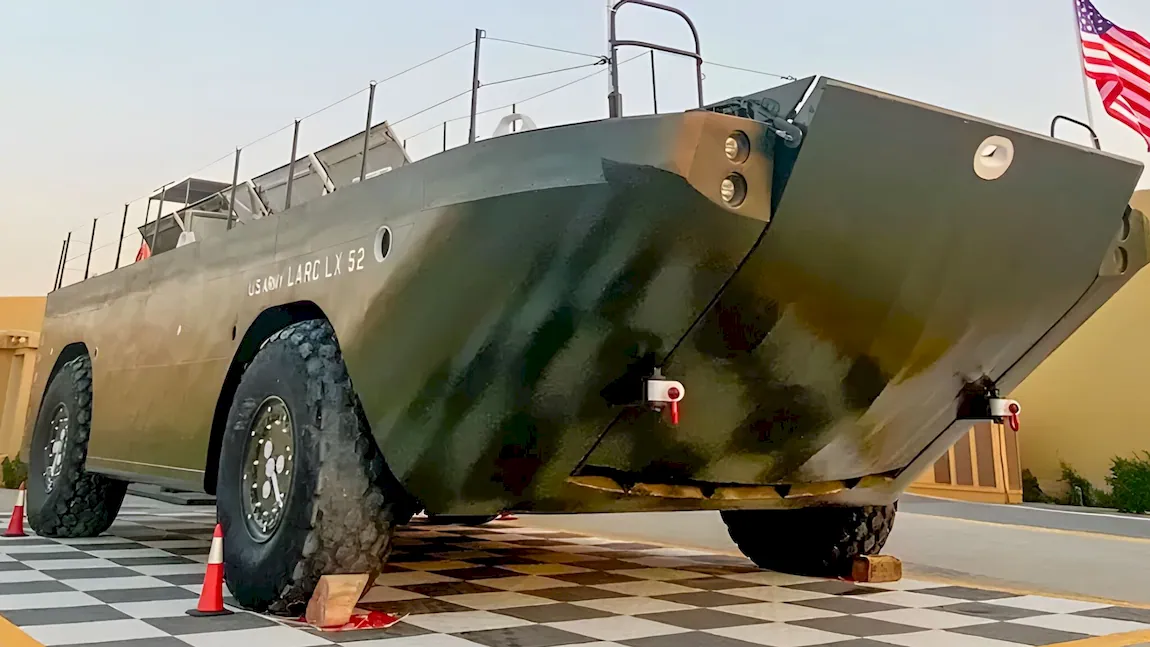
The LARC-LX 52 was built in the United States during the Cold War, when the engineering mindset was simple: if you don’t know how to solve the problem, build it bigger. And in this case, it worked.
The mission was clear — transport heavy military equipment directly from ships to shore, even when there’s no proper port or beach infrastructure. No docks, no cranes, no problem.
LARC-LX 52 dimensions: scale that intimidates

If you think a Freightliner is big, you need to recalibrate. Here are the numbers that make engineers weak in the knees:
- Length: about 62 feet
- Width: roughly 23 feet
- Height: around 18.4 feet
- Empty weight: ~88 tons
- Payload: up to 132 tons on land or around 200 fully equipped troops by water
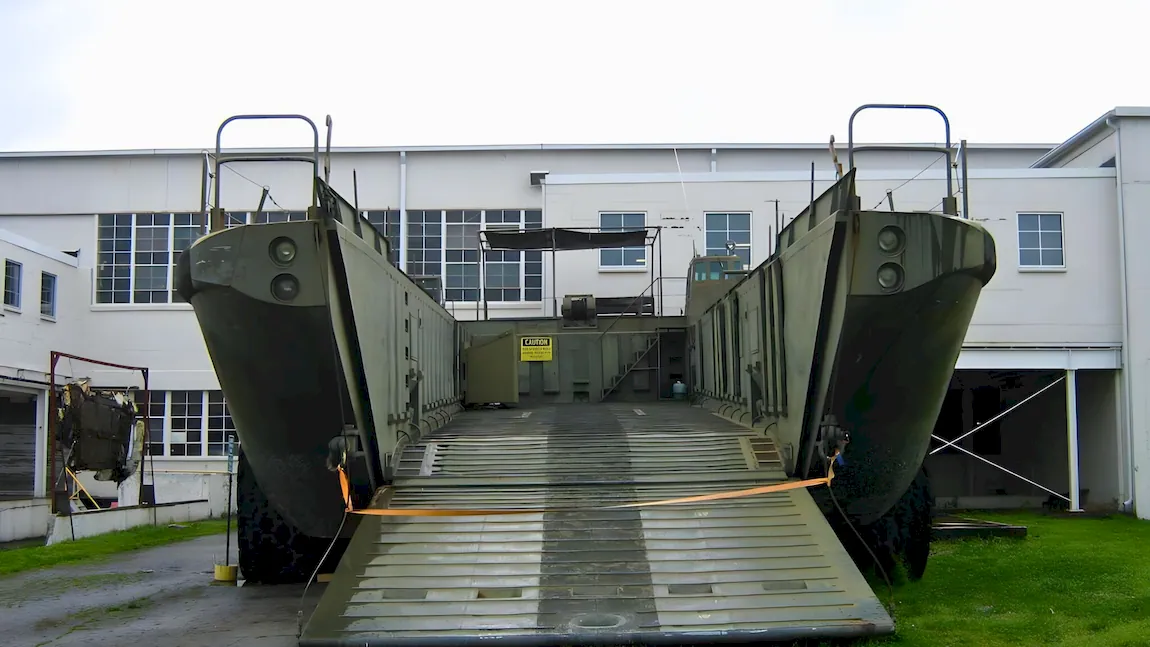
Yes, it can carry a dump truck — and that truck can drive straight on via a front-mounted folding ramp. Loading a semi-truck, however, isn’t always easy: the approach angle is steep, so operators often use a 26,000-lb rear-mounted winch to help pull cargo aboard.
At home on water, confident on land
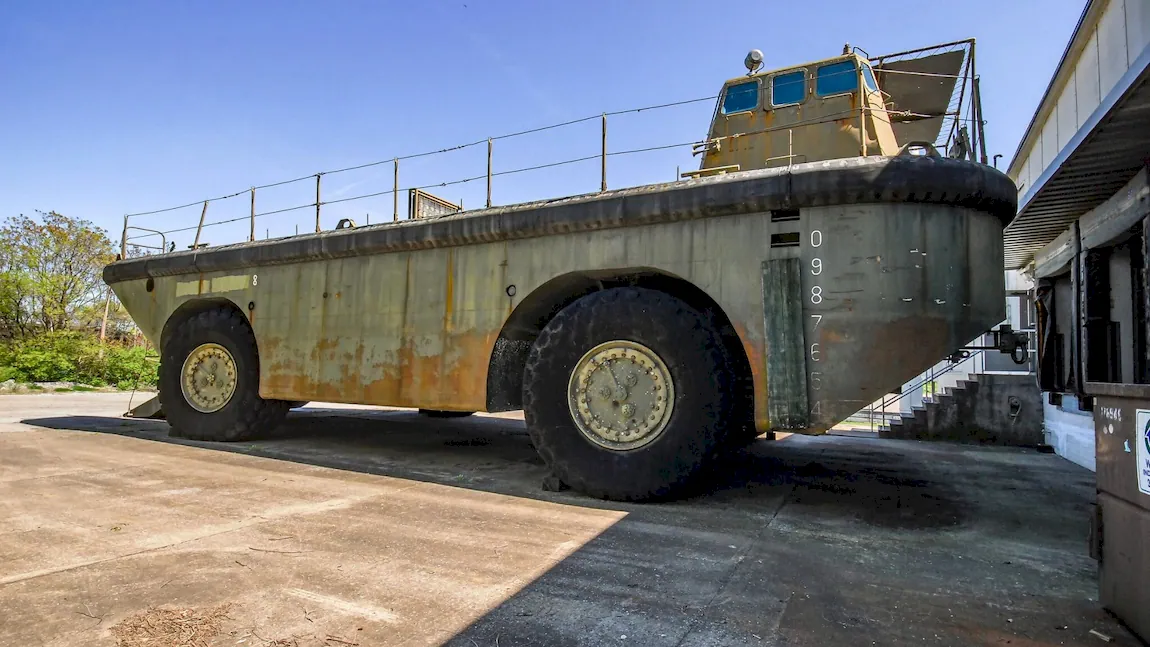
One of the most impressive aspects of the LARC is its true amphibious capability — no “technically floats” compromises here. It features:
- Two full-size marine propellers
- Boat-style rudders
- A reinforced hull with frames and watertight compartments
This behemoth can cruise for dozens of miles on water, even in Sea State 3 conditions. Essentially, it’s a self-propelled floating barge on wheels, capable of unloading cargo directly onto shore.
Top speed is about 9 mph on water and 12 mph on land. That’s right — an 88-ton vehicle moves faster on land than many tractors.
Four wheels, four engines, zero mercy
Here’s where the engineering gets truly wild: each of the four wheels is powered by its own diesel engine.
That’s four 7.0-liter (427-cu-in) diesels, each producing 265 horsepower, connected through automatic transmissions. From each engine, power flows through gearboxes and driveshafts to individual wheels, then through a clutch system to a shared shaft driving the propellers. It’s closer to a locomotive than a truck.
In theory, if one engine fails, the remaining three can still get the vehicle back to base.
The tires are massive Firestone units — about 8.2 feet in diameter and nearly 3 feet wide, larger than those on many mining trucks. Ground pressure is spread so evenly that the LARC doesn’t bog down on soft beaches, even in rain-soaked or fuel-slicked sand.
Where’s the steering wheel, anyway?
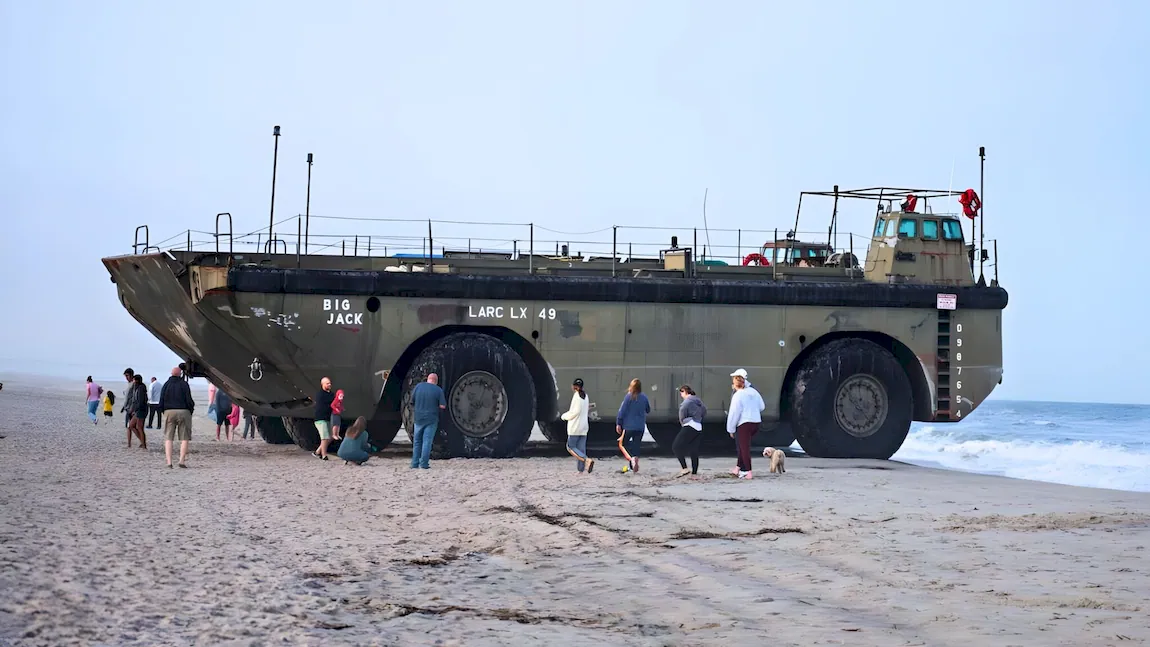
One of the strangest details: the driver’s cab is located at the rear, not the front — just like on a barge. You sit in back, look toward the front ramp, and trust that you’re heading in the right direction.
The cab itself is mostly glass, with a simple bench seat — presumably for the driver and an officer whose job is to shout directions in true military fashion.
All four wheels are steerable, allowing the LARC to nearly pivot in place despite its 62-foot length. Fully loaded, maneuverability decreases, of course — but compared to other amphibious platforms with similar payloads, this thing handles like a jet ski.
The bottom line
The LARC-LX 52 isn’t just a vehicle — it’s an engineering adventure with wheels and propellers. It’s a truck, a ship, an off-road hauler, a tank without a gun, and a boat without cabins — all rolled into one.
It can be launched into the ocean, climb onto shore, load a tractor-trailer, drive inland, and head back into the water — all in one continuous operation, without ports, cranes, or specialized infrastructure.
Today, it remains a unique technological artifact that permanently redefined what an “all-terrain vehicle” can be. And looking at it, you can’t help but say to the engineers of that era:
You were insane. And you were geniuses.
You may also be interested in the news:
Not Ford, BMW or Audi: Mechanic Names the Car Brand That Almost Never Breaks Down
Auto repair professionals reveal which models rarely suffer major failures and which ones repeatedly end up on the lift.

What Does a Flashing Red Traffic Light Mean? Can You Keep Driving?
Drivers must come to a complete stop at the stop line before deciding whether it is safe to proceed.
5 of the Most Beautiful Chevrolet Cars: Timeless Designs With Stunning Silhouettes
Which Chevrolet models deserve to be called the most beautiful?
Nissan Restarts US-Made Murano, Pathfinder, Frontier Sales in Canada
Nissan resumed Canadian sales of three U.S.-built models, but tariffs keep supply below earlier levels.
Why You Should Check a Tire’s Manufacturing Date Before Buying
Tire buyers should check more than size, tread, and brand because rubber changes with age, even without visible wear.